Friday, February 10, 2012

Amazing Addo


Addo Elephant National Park was established in 1935 when there were only 11 individual elephants remaining from the vast herds that roamed the Eastern Cape in South Africa. That small herd of 11 has now grown to over 500 and share the park with Lions, Leopards, Buffalo and Black Rhino making Addo the only National Park that you can see all of the Big Five in a malaria free zone. It has also grown in size to where it is now South Africa’s third largest National Park encompassing some off-shore islands and by so doing has added the Great White Shark (protected in South African waters) and the Southern Right Whale to the Big Five making it now the Big Seven.

Bush Baby at the Gate to Addo

Although during our 4 day stay at Addo we only saw Elephant and Buffalo the encounters we had with them were numerous and exciting.


Stately Matriarch 

Always trying to get the upper hand

Surprise out of the scrub bush

On our early morning game drives, the camp gates open at 6 am and we were one of the first in line, we were lucky enough to see Kudu, Meerkats, Yellow Mongoose and tons of birds. Although about 80% of the roads were dirt they were good and easily driven on by any vehicle.


Nice Kudu


Large Kudu right beside the road


Young male just popped his head up.


Last night's Lion kill!


Black Shouldered Kite

Yellow Mongoose

The rest camp was superb for camping, with each site separated from the next with a row of high bush and trees. The communal bathrooms or ablutions as they called in South Africa were large, clean and well maintained. Each site had its own electric plug and water wasn’t too far away. The restaurant and store served the campers and day trippers with a variety of food and liquid refreshment. Books, maps and souvenirs were readily available.

The Elephants come down to the water holes in droves and although we never counted them we think we easily saw 80 to 100 elephants at one time. The teenagers play in the deep-end which is deep enough to almost cover them completely and the elders and very young hang out at the edge splashing water over their hot bodies with their trunks. As new groups arrive they either wait their turn especially if they have very young or they greet the others with low growls and touches of their trunks and get their fill of water too. Amazing and exciting hours spent at the water holes.


Teenagers in the deep end.


Little ones with their mother at the edge


All in line for a drink

Morning greeting

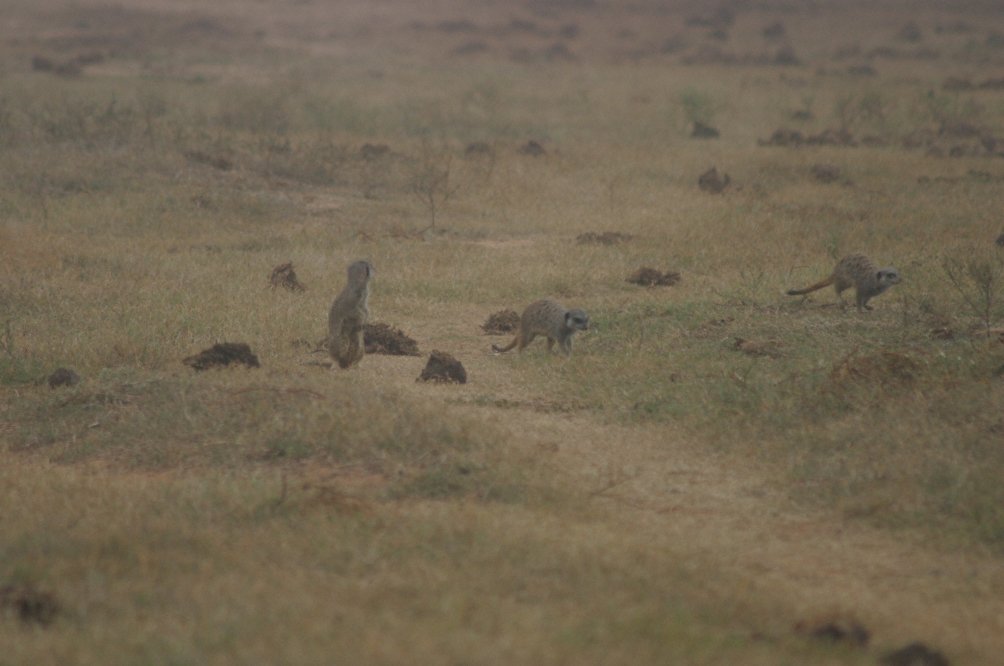
On one of our early mornings at the water hole Annie spotted a large gang of Meerkats hunting on the edge of the area where the Elephants came out of the scrub and we spent a good part of the morning watching Meerkats being Meerkats.

Meerkat gang on the hunt.


Forever vigilant.
Addo was our first African National Park and it certainly exceeded our expectations, being so close to the big city of Port Elizabeth and the famous Garden Route
Old man taking a afternoon snooze.

Photos by Annie and text by Frank.

.

Wednesday, February 8, 2012

Support is Everything


If your computer stops working, the support from tech support is everything.

If your water pipes burst support from your plumber is everything.

But, nothing compares to breaking something 10,000 miles from the nearest repair shop or retail agent. That’s when the support of your manufacture is critical.

We broke our back window beyond repair and sent an urgent email to Marc at XP asking for support. The very next day we heard back from him and he had found a replacement window, worked out the shipping and customs arrangements and here we are 2 weeks later 10,000 miles away with the replacement window installed in South Africa. When you are 10,000 miles away a caring reliable manufacture is everything.

Please realize that we have no sponsors and pay our own way so that we may say everything we may need to say when it necessary!

Saturday, January 21, 2012

The Mysterious Carnet.


While sitting around a campfire with other Overlanders it is often not long before the subject of carnets is brought up. Whether it is someone thinking of going to a country where a carnet might be required or stories of some fellow traveler opting to wing it without a carnet and the adventures they had travelling with an armed guard from the port of entry directly to the nearest border. In all our travels and campfire chats I have never met anyone who had ever even seen this mysterious document. It is almost as if it is the Holy Grail of Overlanders, or that is the way it seemed to me.

So when we started serious planning for our expedition, the carnet, or to use its more formal name Carnet de Passage, was one of our top priorities. A carnet broken down to the simplest terms is a passport for your vehicle to enter a country without paying import duties at the border. Most countries in Africa require either a bond guaranteeing that you will not sell your vehicle in their country or payment of the import duty before you can enter their country with your vehicle.

A carnet guarantees that if you don’t export the vehicle from the country you are entering, the export duty will be paid by the issuer of the carnet. The issuing body of the carnet, in our case CAA (Canadian Automobile Association) calculates the highest import duty of all the countries you will be travelling to and then either requires you to buy an insurance bond or make a cash deposit for that amount.

In our case there were several countries that required 100% of the value of the vehicle as their import duty, others required as little as 50% so CAA charged us 100% of our vehicle’s value. You might think that you could come up with a made-up value and have that suffice. No such luck. The CAA makes good use of Kelly’s Blue Book and the NADA Used Vehicle Guide to get an extremely accurate value. Once you have returned from your trip and have had the carnet correctly stamped you must return it to CAA and then they will release you from the carnet and either return your cash deposit or if you bought the insurance they will send you back about 40% of your premium.

To get our carnet we contacted CAA in Ottawa and they pointed us to their website where we downloaded the application. We attached a couple of photos of the truck with the camper on it to the application, wrote them a check for the processing fee and sent them via Fedex to Ottawa. Within a couple weeks they came-up with the bond or cash payment price. We then sent them the payment and within another 6 weeks we had our carnet.

The cover is quite simple as you can see:


The individual pages are the heart of the document. They consist of 3 parts. The bottom part is detached by customs when you enter a country and they stamp and sign the left hand side of the top part. Then the middle section is detached by customs when you leave a country and they stamp and sign the right hand side of the top section. This is the most important task that needs to be done when you leave a country. They won’t ask for the carnet when you leave only when you arrive so it is up to you to get it signed and stamped upon exiting a country.


The back cover page lists the countries that the carnet is valid for.

As you can see the carnet is only valid for a year, but it is possible to renew it.

We were very pleased to have a carnet when the vehicle arrived in East London and so was the customs clearing agent as it made his job much easier. I am not sure what it would have cost or how long it would have taken to clear customs without the carnet, but with it all fees including the agents fees, customs fees, dock fees and stevedore fees it came to under $700.00 and it took about a day to complete all the necessary paper work and of course the inspection of the camper.

Not bad I thought.


Bush Baby with Jonathan, our agent, on the docks in East London right after they had released her to us.


Bush Baby in the courtyard of the Guest House in East London. We had just added the Left Hand Drive sticker and the South African flag.

Friday, December 30, 2011

The XP Camper Build

We started with 2010 Chevy 4X4 3500HD long bed, extended cab with a 6 liter gas engine. We have the snow-plow package which beefs-up the front suspension for the Off-Road Bumper. It also included most of what you get with the off-road package like the locking-diff.


Ripped out the back seats and installed a 3/4 inch plywood sub-floor.


Cut some insulation for the back side windows, not only to keep the heat out but to also hide the stuff in the back from prying eyes.


This was the original plan and would have worked, but we found this fantastic stuff called Smash and Grab film that not only darkens the windows so you can't see in but also protects the glass from being smashed by an intruder! Watch this incredible YouTube video to see what I mean:


We couldn't get this stuff anywhere on the East coast so we had it installed on all 4 side windows by RD Window Tint in Colorado Springs on our way out to have the flatbed done. 

Next stop Layne of Denver Off Road in Grand Junction CO to get the flatbed and bumpers installed.

 Off with the bumper
Off with the bed
On with the flatbed

Meanwhile Marc is building the XP in California

Popping it out of its mold
Then putting the pieces together like Lego blocks.
Annie and Marc discussing where the toilet paper holder should go. I kid you not, this was a half-hour conversation. That is what happens when a German who is fanatical about detail and a New Englander who is equally fanatical about detail get together. God bless them both.


That damn door
Final touches before we do a test load onto the truck
Dinette cushions and kitchen sink
Great teak floor
Shower and toilet with real teak slats on floor
Back to Layne in Colorado to replace the ladder with a beefier version.
 That is Layne on the right.
The sand-ladders bolted under the flatbed on slides.
They became the foundation for our slide-out table but that is another story.
New steps with skid pads installed
Rear bumper and the back door on flatbed that hides my slide-out table.

And here we have the 'almost' finished expedition Camper.
I say 'almost' because there is always something else that you need.


In our case we wanted to beef up the suspension for our expedition so we had Super Springs installed on the rear, Sumo springs on the front and we raised the front end 3 inches with a new key from Central 4 Wheel Drive in Sacramento.

We also bought steel 19.5" wheels from Rickson with Michelin XDS2 245/75/19.5 tires. 

Rickson wheels installed.

Now we are ready to ship her, but what about tools and spare parts? It is so hard to decide what to take and what to leave behind when we are going to be gone for 2 years and maybe longer!
Here is the collection I am taking. Spanners and screwdrivers have their own wrap-around cloth/canvas bags that Annie made to stop them banging into each other on the rough roads and it also keeps them well organized.
Thankfully everything fits in 2 tool boxes that slide under the sub-floor in the back of the cab.
Here is Bush Baby on the dock in Baltimore waiting for the ship to arrive. She does have a campervan from Germany and a motorhome from Norway to keep her company.

Now what do we do for 3 weeks while she is in transit, oh I know let's update the blog in between getting all the other things that need to be done for international travel.

Tuesday, October 11, 2011

Farewell Australia

Our original plan was to ship the Trakka to Durban, South Africa and then continue our Adventure in Africa. However, best laid plans.... Once back in the United States Annie got very sick and we thought our travels were over with! So, we had Martin sell our beloved Trakka for us. Again there was a huge trust involved as we gave him all the authority and he could have said or done anything, but in just a few short weeks he had our camper sold for a very fair price and we had the money in our bank account. Thanks again Martin.

Some final photos from our Australian adventure and it truly was an exciting adventure.

OMG:


Around every corner is another surprise:

Piano in tree marks the exact spot where one landed during a 100 year flood!


Only dingo we saw in 3 months.

On the road to Emerald.


Australian possum visited our camp.
We were lucky to see tons of Koala bears in the wild.


Guess what he is selling!

Wide variety of noisy Australian birds:


And some not so noisy birds:

Family of ducks came visiting.